

It's a winter morning. You can't get out of bed. You hit the snooze button repeatedly, finally getting up at the last possible minute. You rush to get ready, run to the station in the dim light, squeeze onto a train or tram, and finally catch your breath. Yet, your head feels foggy. Your engine doesn't start all morning, and before you know it, it's lunch time.
Does this sound familiar?
There is a saying common in many cultures: "The early bird catches the worm." People in the past knew intuitively, without needing scientific explanations, that waking up early and bathing in the sun felt good.
But what about us today? We scroll through our smartphones until late at night and sleep until the last second in the morning. We commute via underground tunnels and spend the day under fluorescent lights in the office. Sometimes we realise in the evening, "Did I even breathe outside air today?"
Recently, the link between this "light-deprived lifestyle" and physical ailments has become scientifically clear. In 2017, researchers who unraveled the mechanisms of the biological clock were awarded the Nobel Prize. There is a legitimate reason why "bathing in the morning sun feels good."
In this article, we will explain as clearly as possible what happens in your body when you bathe in the morning sun and why it affects your sleep and mood. By the time you finish reading, you'll be eager to throw open your curtains tomorrow morning.
1. What is the Body Clock?
Our bodies have an invisible "clock."
This clock operates on a cycle of roughly 24 hours, telling various bodily functions, "It's time to get sleepy" or "It's time to wake up." It manages everything from sleep-wake rhythms to body temperature fluctuations, hormone secretion, and even gastrointestinal activity.
This mechanism is called the "Body Clock" or scientifically, the "Circadian Rhythm." Think of it as a built-in alarm clock inside your body.
What's interesting is that this body clock is "about 24 hours," not exactly 24 hours. Research suggests the human body clock averages about 24.2 hours. In other words, if you do nothing, it will drift slightly every day.
So, how do we synchronise it to Earth's 24-hour day?
The answer is Morning Sunlight. By bathing in light every morning, the body clock is reset, effectively saying, "Okay, let's start the day here." Because of this mechanism, we can maintain a rhythm where we get sleepy at night and wake up in the morning.
| Time of Day | Body State |
|---|---|
| Early Morning (Wake up) | Body temperature starts to rise; preparing to wake up. |
| Morning | Mind is sharp; concentration tends to peak. |
| Afternoon | Body temperature peaks; suitable for physical activity. |
| Evening to Night | Body temperature slowly drops; preparation for sleep begins. |
| Late Night | Body repair work and memory consolidation occur. |
Does this rhythm feel familiar? Work requiring focus goes well in the morning, or you get a bit sleepy after lunch. That's all the work of your body clock.
2. What Happens Inside Your Body When You See Sunlight
So, what happens inside your body the moment you bathe in the morning sun? It gets a bit technical here, but knowing this makes it much more convincing.
Special Sensors That Catch Light
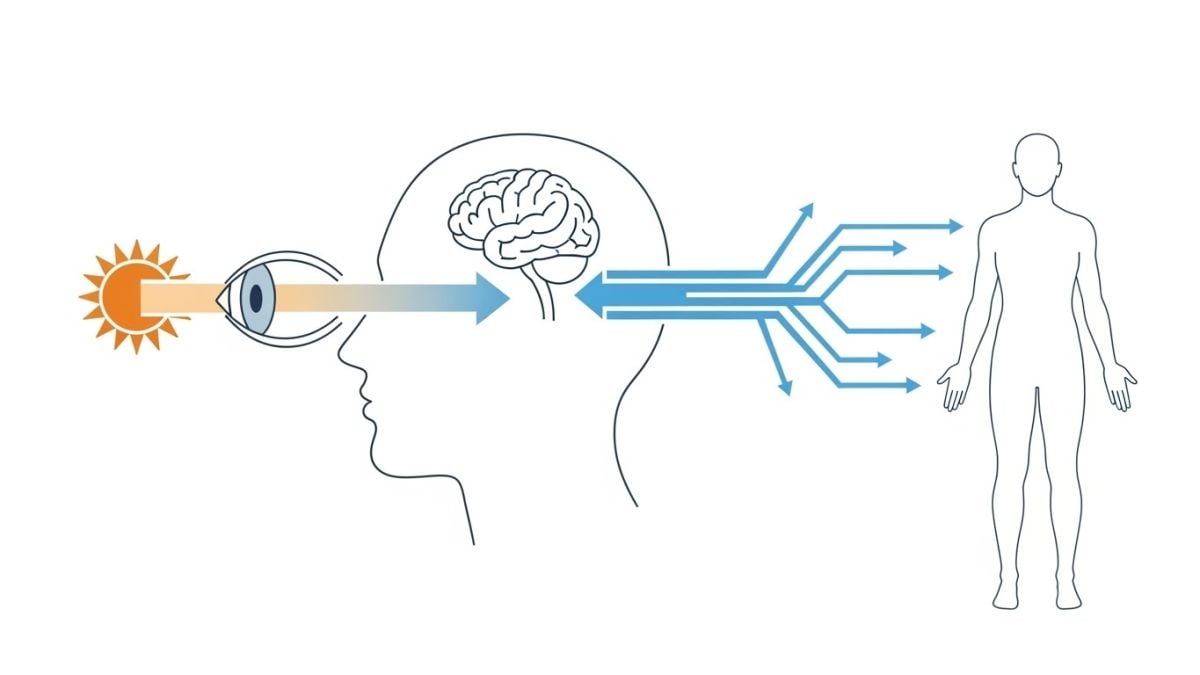
Our eyes have special sensors for sensing "brightness," separate from the cells used for seeing objects. This is a relatively new discovery made between the 1990s and 2000s.
These sensors react strongly to "blue light." Sunlight contains plenty of this blue wavelength. So when you bathe in the morning sun, the sensors react: "Oh, it's bright!"
The "It's Morning!" Call to the Brain
The light information caught by the sensors reaches the "Body Clock Control Centre" (the Suprachiasmatic Nucleus) deep in the brain via nerves. The control centre then issues a command to the whole body: "Morning is here, wake up!"
Here is the interesting part. A major switch in hormones occurs.
First, the secretion of "Melatonin," the hormone that encourages sleep, stops abruptly. With the melatonin that was flowing during the night now gone, the body switches into "Awake Mode."
Instead, "Serotonin" becomes active. This is a substance that stabilises mood and increases motivation. That positive feeling of "Let's give it a go today" is thanks to serotonin.
Furthermore, serotonin is used as a raw material for melatonin at night. In other words, making plenty of serotonin in the morning leads to sound sleep at night. Morning and night are connected.
3. The Benefits of Morning Sunlight
We hear that "morning sun is good for the body," but what exactly is good about it? Let's organise what we know from research.
You'll Sleep Better at Night
This is an effect many people feel easily. When you get enough light in the morning, the timing for natural sleepiness at night comes more easily. We often hear people say, "I fall asleep faster," or "I don't wake up in the middle of the night anymore."
When someone says, "I haven't been sleeping well lately," I ask, "Are you getting morning light?" Sleep problems often stem from how you spend your morning.
Your Engine Starts in the Morning
If you can switch fully to awake mode in the morning, your brain works clearly from the start. People who say "my engine doesn't start until the afternoon" might be lacking morning light.
This isn't just about work or study. On the weekend, you might laze around and realise it's past noon. "I didn't do anything today," you regret. If you have such experiences, try stepping outside once in the morning. Just a 10-minute walk can change how you use your time afterward.
Mood Stabilises
Serotonin is also called the "happiness hormone." When morning sun stimulates serotonin secretion, mood swings tend to settle.
Especially in winter, when days are short, some people feel depressed. This is particularly relevant in southern states like Tasmania and Victoria. "Light Therapy"—bathing in strong light in the morning—is a widely practiced method for combatting winter blues in high-latitude regions.
4. Best Times and Conditions for Maximise Effect
"I get that I should bathe in the morning sun. But how?"
Here, we will tell you the specific conditions to maximise the effect, while keeping Australian sun safety in mind.
Light Within 30 Minutes of Waking
The most important thing is not to leave too much time after waking up. Ideally, you want to get bright light into your eyes within 30 minutes, or at the latest, within an hour of waking up.
If you stay in a dark room looking at your smartphone for a while and only go out near noon, the body clock reset effect weakens.
10-30 Minutes is Enough
You don't need to bathe in it for a long time. 10 to 30 minutes is sufficient. You don't need to be under the sun for hours. Given the high UV levels in Australia, it is important not to overdo it.
Outdoors is Best
This is a point often overlooked, but the brightness indoors and outdoors is completely different.
Standard office or home lighting is about 300-500 lux. On the other hand, even on a cloudy day, outdoors is 2,500-10,000 lux. On a sunny Australian day, it can be 10,000-100,000 lux. The magnitude is different.
| Environment | Brightness (Lux) |
|---|---|
| Indoor Lighting (Office/Home) | 300 - 500 |
| Cloudy Day Outdoors | 2,500 - 10,000 |
| Sunny Day Shade | 10,000 - 25,000 |
| Sunny Day Direct Sunlight | 50,000 - 100,000 |
You might think, "I'm by the window, so I'm fine," but glass reduces light intensity, and buildings cast shadows. If possible, step outside, even for a short time.
No Need to Stare at the Sun
Just to be clear, you absolutely do not need to stare directly at the sun. In fact, please don't, as it damages your eyes. Being in a bright outdoor environment and naturally letting light enter your eyes is enough.
However, wearing sunglasses reduces the effect. Try walking without sunglasses for your morning walk, provided the sun isn't too harsh yet.

5. Seasonal and Regional Differences in Sunrise
Sunrise times vary significantly depending on the season and where you live. Knowing this helps when planning your life rhythm.
More Than 2 Hours Difference Between Summer and Winter
For example, in Sydney, sunrise on the Summer Solstice (late December) is around 5:40 AM. On the Winter Solstice (late June), it's around 7:00 AM. That's a significant difference.
Feeling that "it's hard to wake up" in winter isn't just because of the cold. Even when the alarm goes off, it might still be pitch black outside. It's natural that your engine is slow to start when the day begins without the light that resets your body clock.
It Changes Where You Live
In regions near the equator, like Darwin or Far North Queensland, sunrise and sunset times don't change much throughout the year. But in southern regions like Hobart or Melbourne, the difference is much more pronounced. In Tasmanian winters, days can be quite short.
People living in high-latitude areas often use artificial light cleverly to adjust their body clocks.
First, Know Your Local Sunrise
The first step to regulating your body clock is to know the sunrise time in your area. If you know how it changes with the seasons, it's easier to adjust: "I'll go to bed a bit earlier in winter" or "I'll wake up early and be active in summer."
▶ Check sunrise times in your area: https://worldsunmoon.com/en-au/sun/
6. What Happens When Your Body Clock is Off?
If your body clock remains disrupted, your body will send out various signals. If it's just "feeling a bit sluggish," that's one thing, but neglecting it can lead to serious issues.
Insomnia and Difficulty Waking Up
The most obvious issue is sleep. You don't get sleepy at night. Even if you sleep, you wake up many times. Waking up in the morning is painful. If you recognise these symptoms, suspect a disruption in your body clock.
Chronic lack of sleep leads to daytime drowsiness and increased mistakes. Some might have had close calls while driving.
Weight Gain?
Recent research has shown that body clock disruption also affects metabolism. There are reports that people who work night shifts for a long time have a higher risk of obesity and diabetes. Even if you eat the same food, the effect on your body might differ depending on the time of day you eat.
This is still a developing field of research, but the rule of thumb that "late-night snacks lead to weight gain" may have scientific backing.
Emotional Instability
Body clock disruption affects mood too. Feeling irritable, unmotivated, or depressed without a reason. These symptoms and poor sleep quality are closely related.
People Who Should Be Careful
Shift workers, people with frequent international travel, night owls, and people who rarely go outside during the day. If this fits you, you should consciously manage how you get light.
7. Common Misconceptions
There are quite a few misunderstandings about body clocks and light. Let's clear up the representative ones.
"Isn't turning on the room lights enough?"
Unfortunately, the brightness of indoor lighting and sunlight is different by an order of magnitude. No matter how bright the room is, the light intensity is often insufficient to reset the body clock. "I have all the lights on, so it's fine" doesn't quite work.
"Are cloudy days useless?"
This is also a common misunderstanding. Even on cloudy days, simply going outdoors exposes you to many times more light than being indoors. Even on rainy days, it's worth stepping outside. Don't use the weather as an excuse.
"The longer, the better, right?"
10 to 30 minutes is enough. Bathing in sunlight for hours doesn't significantly change the effect on the body clock. Instead, you should worry about skin damage from UV rays. Efficient, short exposure is the correct answer.
"Is blocking blue light at night enough?"
Avoiding blue light from smartphones at night is certainly effective. But that alone is only half the battle. Morning light input and evening light restriction—both sets produce results. One without the other is insufficient.
8. Morning Light Habits to Start Today
We understand the theory. So, what exactly should we do?
You don't need special tools. It costs no money. With just a pile of small habits, your body clock will align.
First, Open the Curtains
When you wake up, just open the curtains. This alone dramatically increases the amount of light entering the room. If possible, using sheer curtains rather than block-out curtains can help you wake up naturally.
Breakfast by the Window
If you have brekkie, do it at a table by the window. You can naturally bathe in light while eating. Even on a busy morning, you can do this.
Go Outside for Just 10 Minutes
The most effective thing is, after all, to go outdoors. Walk to the station. Go out to take out the rubbish. Walk to a café to buy a coffee. Walk the dog. Drink tea on the verandah or balcony.
10 minutes is fine. 15 minutes is fine. This act of "going outside" resets the body clock most powerfully.
If you work from home and go out less, try to set aside time for a walk in the morning. It resolves lack of exercise and clears your head. Personally, when I made morning walks a habit while working from home, my productivity in the afternoon was completely different.
Limit Light at Night
To make the most of morning light, how you spend your night is also important. Switch room lighting to warm colours in the evening. Limit smartphones and computers 1-2 hours before bed. Sleep in a bedroom as dark as possible.
If you stay up late, bathe in the morning sun, and stay up late again, you won't see results. By being conscious of both morning and night, your body clock stabilises.
9. Alternatives to Sunlight
"Sunrise is too late in winter to see the sun before work," or "I can't get time to go outside due to work."
For such people, there are ways to use artificial light.
Light Therapy Boxes
Dedicated lights made for light therapy can emit a brightness of 10,000 lux or more. Placing this light near your face for about 30 minutes while eating breakfast can provide an effect close to sunlight.
They are medically recognized as a treatment for winter depression. Points to choose are: brightness of 10,000 lux or more, UV cut, and products from reliable manufacturers.
Know the Precautions
Light therapy lamps are convenient, but there are precautions. People with eye diseases should consult a doctor before use. Also, using them in the evening can be counterproductive and keep you awake at night. Use is limited to the morning.
And remember, light therapy lamps are just a substitute for sunlight. If possible, real morning sun is best.
10. Frequently Asked Questions
Q. What is the ideal time to wake up?
You don't need to match sunrise exactly. The important thing is to bathe in light as soon as possible after waking up. Whether you wake up at 6 AM or 8 AM, if you bathe in bright light within 30 minutes of waking, it's fine. However, if you live an extreme night-owl life waking up in the afternoon, it's better to shift it earlier little by little.
Q. Is it effective even if my eyes are closed?
Light reaches through eyelids to some extent, but the effect weakens. Ideally, keep your eyes open and look in a bright direction. Again, there is no need to stare directly at the sun.
Q. What should shift workers do?
Honestly, this is a difficult problem. The basic idea is to bathe in light before the start of a shift to enter awake mode, and use sunglasses to avoid light when returning home to make it easier to sleep. However, the optimal solution differs depending on the shift pattern, so if you are struggling, we recommend consulting a sleep specialist.
Q. Is it effective for children?
Yes. Children are actually said to be more susceptible to the influence of light. Wake them up with natural light, have breakfast in a bright room, walk outside to school. These habits stabilise children's sleep rhythms. Limiting screen time at night is also important.
Q. I feel depressed in winter. Will this help?
Light therapy is established as a treatment for "Seasonal Affective Disorder (SAD)." If symptoms are mild, simply being conscious of morning light exposure may improve them. But if symptoms are severe, please try a light therapy lamp or consult a medical institution. You don't have to endure it.
Summary
When you bathe in the morning sun, special sensors deep in your eyes send a signal to your brain: "Morning has come." Then the body switches to awake mode, the sleep hormone recedes, and the motivation hormone comes out. By this mechanism working properly every day, a virtuous cycle is created: you sleep well at night, wake up refreshed in the morning, and your mind is clear during the day.
The point to get the effect is to bathe in light outdoors for about 10-30 minutes within 30 minutes of waking up. It is effective even on cloudy days, and no special tools are needed.
Our ancestors lived a life of waking with the sun and sleeping with the sun for tens of thousands of years. Modern life has become far removed from that environment. That is why it is important to consciously incorporate morning light.
It's not difficult. Tomorrow morning, when you wake up, open the curtains and breathe a little outside air. That alone might change how your day begins.
▶ Check today's sunrise time: https://worldsunmoon.com/en-au/sun/
References
- Jeffrey C. Hall, Michael Rosbash, Michael W. Young "Discoveries of molecular mechanisms controlling the circadian rhythm" (2017 Nobel Prize in Physiology or Medicine)
https://www.nobelprize.org/prizes/medicine/2017/summary/ - Sleep Foundation "Light and Sleep"
https://www.sleepfoundation.org/bedroom-environment/light-and-sleep - Harvard Medical School "Blue light has a dark side"
https://www.health.harvard.edu/staying-healthy/blue-light-has-a-dark-side - NIH (National Institutes of Health) "Circadian Rhythms"
https://www.nigms.nih.gov/education/fact-sheets/Pages/circadian-rhythms.aspx