

It's a winter morning. You can't get out of the quilt (razai). You hit the snooze button repeatedly, finally getting up at the last possible minute. You rush to get ready, run to catch the Metro or drive through traffic, and reach the office just in time. Yet, your head feels foggy. Your engine doesn't start all morning, and before you know it, it's lunch time.
Does this sound familiar?
We have all grown up hearing the proverb: "**Early to bed and early to rise, makes a man healthy, wealthy, and wise.**" Our elders knew intuitively, without needing scientific explanations, that waking up early and soaking in the sun was essential for a healthy life.
But what about our lifestyle today? We scroll through our smartphones until late at night and sleep until the last second in the morning. We spend our days in air-conditioned offices under fluorescent lights. Sometimes we realise in the evening, "Did I even step out today?"
Recently, the link between this "light-deprived lifestyle" and health issues has become scientifically clear. In 2017, researchers who unraveled the mechanisms of the biological clock were awarded the Nobel Prize. There is a legitimate reason why soaking in the morning sun feels so good.
In this article, we will explain simply what happens in your body when you bathe in the morning sun and why it affects your sleep and mood. By the time you finish reading, you'll be eager to throw open your curtains tomorrow morning.
1. What is the Body Clock?
Our bodies have an invisible "clock."
This clock operates on a cycle of roughly 24 hours, telling various bodily functions, "It's time to get sleepy" or "It's time to wake up." It manages everything from sleep-wake rhythms to body temperature fluctuations, hormone secretion, and even digestion.
This mechanism is called the "Body Clock" or scientifically, the "**Circadian Rhythm**." Think of it as a built-in alarm clock inside your body.
What's interesting is that this body clock is "about 24 hours," not exactly 24 hours. Research suggests the human body clock averages about 24.2 hours. In other words, if you do nothing, it will drift slightly every day.
So, how do we synchronise it to Earth's 24-hour day?
The answer is Morning Sunlight. By bathing in light every morning, the body clock is reset, effectively saying, "Okay, let's start the day here." Because of this mechanism, we can maintain a rhythm where we get sleepy at night and wake up in the morning.
| Time of Day | Body State |
|---|---|
| Early Morning (Wake up) | Body temperature starts to rise; preparing to wake up. |
| Morning | Mind is sharp; concentration tends to peak. |
| Afternoon | Body temperature peaks; suitable for physical activity. |
| Evening to Night | Body temperature slowly drops; preparation for sleep begins. |
| Late Night | Body repair work and memory consolidation occur. |
Does this rhythm feel familiar? Work requiring focus goes well in the morning, or you feel lazy after lunch. That's all the work of your body clock.
2. What Happens Inside Your Body When You See Sunlight
So, what happens inside your body the moment you bathe in the morning sun? It gets a bit technical here, but knowing this makes it much more convincing.
Special Sensors That Catch Light
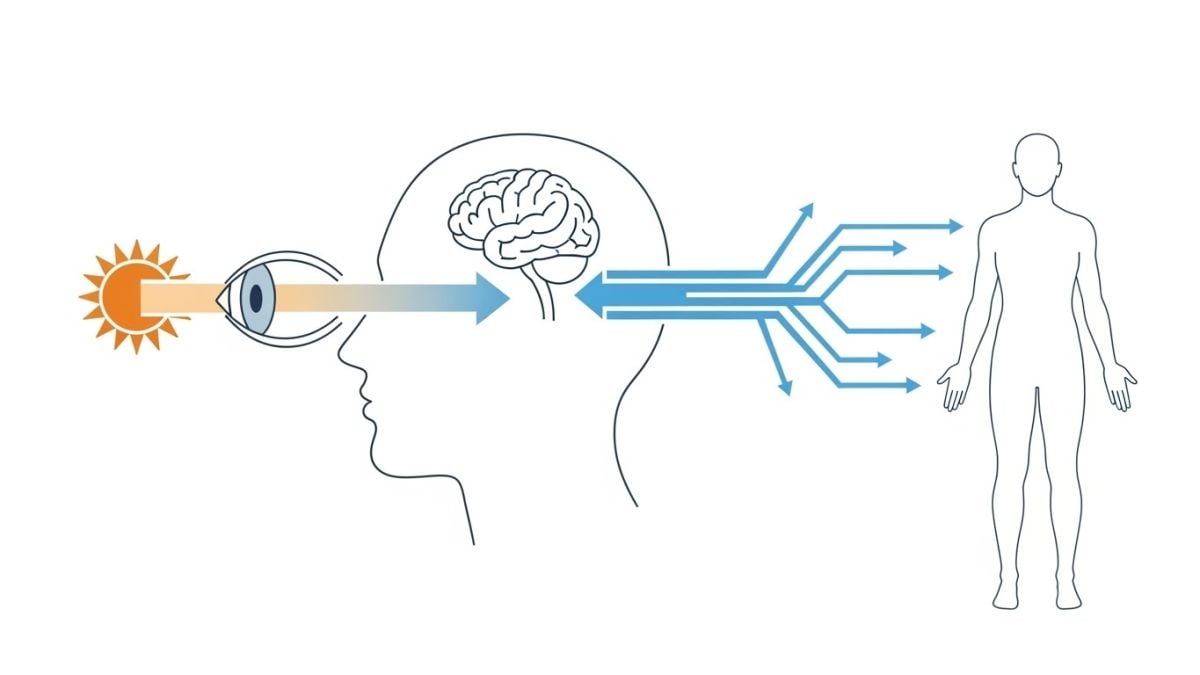
Our eyes have special sensors for sensing "brightness," separate from the cells used for seeing objects. These sensors react strongly to "blue light." Sunlight contains plenty of this blue wavelength. So when you bathe in the morning sun, the sensors react: "Oh, it's bright!"
The "It's Morning!" Call to the Brain
The light information caught by the sensors reaches the "Body Clock Control Centre" (the Suprachiasmatic Nucleus) deep in the brain. The control centre then issues a command to the whole body: "Morning is here, wake up!"
Here is the interesting part. A major switch in hormones occurs.
First, the secretion of "Melatonin," the hormone that induces sleep, stops abruptly. With the melatonin that was flowing during the night now gone, the body switches into "Awake Mode."
Instead, "Serotonin" becomes active. This is a substance that stabilises mood and increases motivation. That positive feeling of "Let's do this today" is thanks to serotonin.
Furthermore, serotonin is used as a raw material for melatonin at night. In other words, making plenty of serotonin in the morning leads to sound sleep at night. Morning and night are connected.
3. The Benefits of Morning Sunlight
We hear that "morning sun is good for the body," but what exactly is good about it? Let's organise what we know from research.
You'll Sleep Better at Night
This is an effect many people feel easily. When you get enough light in the morning, the timing for natural sleepiness at night comes more easily. We often hear people say, "I fall asleep faster," or "I don't wake up in the middle of the night anymore."
If someone says, "I haven't been sleeping well lately," I ask, "Are you getting morning light?" Sleep problems often stem from how you spend your morning.
Your Engine Starts in the Morning
If you can switch fully to awake mode in the morning, your brain works clearly from the start. People who say "my engine doesn't start until the afternoon" might be lacking morning light.
This isn't just about work or study. On Sunday mornings, you might laze around and realise it's past noon. "I didn't do anything today," you regret. If you have such experiences, try stepping outside once in the morning. Just a 10-minute walk can change how you use your time afterward.
Mood Stabilises
Serotonin is also called the "happiness hormone." When morning sun stimulates serotonin secretion, mood swings tend to settle.
4. Best Times and Conditions for Maximum Effect
"I get that I should bathe in the morning sun. But how?"
In India, the sun can be very harsh. Here are the specific conditions to maximise the effect safely.
Light Within 30 Minutes of Waking
The most important thing is not to leave too much time after waking up. Ideally, you want to get bright light into your eyes within 30 minutes, or at the latest, within an hour of waking up.
10-30 Minutes is Enough
You don't need to bathe in it for a long time. 10 to 30 minutes is sufficient. In the Indian summer, avoid the midday sun. The gentle sun (gunguni dhoop) **before 9 AM** is best for both your body clock and your skin.
Outdoors is Best
This is a point often overlooked, but the brightness indoors and outdoors is completely different.
Standard office or home lighting is about 300-500 lux. On the other hand, even on a cloudy day, outdoors is 2,500-10,000 lux. On a sunny day in India, it can be 50,000-100,000 lux. The magnitude is different.
| Environment | Brightness (Lux) |
|---|---|
| Indoor Lighting (Office/Home) | 300 - 500 |
| Cloudy Day Outdoors | 2,500 - 10,000 |
| Sunny Day Shade | 10,000 - 25,000 |
| Sunny Day Direct Sunlight | 50,000 - 1,00,000 |
You might think, "I'm by the window, so I'm fine," but glass reduces light intensity. If possible, step out onto your balcony or terrace.
No Need to Stare at the Sun
Just to be clear, you absolutely do not need to stare directly at the sun. Being in a bright outdoor environment and naturally letting light enter your eyes is enough. Doing *Surya Namaskar* (Sun Salutation) facing the east is a perfect traditional way to combine this with exercise.

5. Seasonal and Regional Differences in Sunrise
India is a vast country, and sunrise times vary significantly depending on the season and location.
North India vs South India
In South India (like Bengaluru or Chennai), sunrise times don't change drastically throughout the year. However, in North India (like Delhi or Punjab), there is a significant difference between summer and winter. In summer, the sun is up by 5:30 AM, but in winter, it might be 7:15 AM.
The Challenge of Winter Fog and Monsoon
In North Indian winters, fog can be an issue. During the Monsoon season across the country, clouds often hide the sun. But remember, even through fog or clouds, the outdoor light is significantly brighter than your tube lights inside. Don't use the weather as an excuse to stay in bed.
First, Know Your Local Sunrise
The first step to regulating your body clock is to know the sunrise time in your city. Knowing this helps you plan your "Morning Walk" or yoga routine better.
▶ Check sunrise times in your area: https://worldsunmoon.com/en-in/sun/
6. What Happens When Your Body Clock is Off?
If your body clock remains disrupted, your body will send out various signals. If it's just "feeling a bit lazy," that's one thing, but neglecting it can lead to serious issues.
Insomnia and Difficulty Waking Up
The most obvious issue is sleep. You don't get sleepy at night. Even if you sleep, you wake up many times. Waking up in the morning is painful. If you recognise these symptoms, suspect a disruption in your body clock.
Weight Gain?
Recent research has shown that body clock disruption also affects metabolism. There are reports that people who work night shifts (common in the BPO/IT sector) have a higher risk of obesity and diabetes. Late-night snacking affects the body differently than daytime eating.
Emotional Instability
Feeling irritable, unmotivated, or low without a reason. These symptoms and poor sleep quality are closely related.
7. Common Misconceptions
There are quite a few misunderstandings about body clocks and light. Let's clear up the representative ones.
"Isn't turning on the room lights enough?"
Unfortunately, the brightness of indoor lighting and sunlight is different by an order of magnitude. "I have all the lights on, so it's fine" doesn't quite work for resetting the biological clock.
"Are cloudy days useless?"
This is also a common misunderstanding. Even on cloudy days or during the monsoon, simply going outdoors exposes you to many times more light than being indoors. Step out onto the balcony.
"The longer, the better, right?"
10 to 30 minutes is enough. Bathing in the harsh Indian sun for hours doesn't significantly change the effect on the body clock, and you risk tanning or sunburn.
"Is blocking blue light at night enough?"
Avoiding smartphones at night is certainly effective. But that alone is only half the battle. Morning light input and evening light restriction—both sets produce results.
8. Morning Light Habits to Start Today
We understand the theory. So, what exactly should we do?
You don't need special tools. It costs no money. With just a pile of small habits, your body clock will align.
First, Open the Curtains
When you wake up, just open the curtains. Let the light flood in. This is the first signal to your brain.
Chai on the Balcony
If you love your morning tea (chai) or coffee, take it to the balcony, terrace, or sit by a large window. Enjoying your drink while soaking in natural light is the easiest way to start.
Go for a Morning Walk
The most effective habit is the "Morning Walk." Walk to the park, or just around your society complex. 10-15 minutes is fine. This act of "going outside" resets the body clock most powerfully and gives you fresh air.
Limit Light at Night
To make the most of morning light, how you spend your night is also important. Use warm yellow lights in the evening. Limit usage of mobile phones 1-2 hours before bed.
9. Alternatives to Sunlight
"I leave for office before sunrise" or "My flat doesn't get any sunlight."
For such people, there are ways to use artificial light.
Light Therapy Lamps
Dedicated lights made for light therapy can emit a brightness of 10,000 lux or more. Using this light near your face for about 30 minutes while having breakfast can provide an effect close to sunlight.
10. Frequently Asked Questions
Q. What is the ideal time to wake up?
You don't need to match sunrise exactly. The important thing is to bathe in light as soon as possible after waking up. Whether you wake up at 6 AM or 8 AM, if you bathe in bright light within 30 minutes of waking, it's fine.
Q. Is it effective even if my eyes are closed?
Light reaches through eyelids to some extent, but the effect weakens. Ideally, keep your eyes open. You can do yoga or read the newspaper.
Q. What should night shift workers (BPO/IT) do?
This is a common challenge in India. The basic rule is: get bright light before your shift starts (to "wake up"), and wear sunglasses when commuting back home in the morning (to avoid the "wake up" signal so you can sleep). Use blackout curtains in your bedroom.
Q. Is it effective for children?
Yes. Send them to the school bus stop walking, or encourage outdoor play in the morning. This helps them sleep better at night.
Summary
When you bathe in the morning sun, special sensors in your eyes send a signal to your brain: "Morning has come." Then the body switches to awake mode, the sleep hormone recedes, and the motivation hormone comes out. By this mechanism working properly every day, a virtuous cycle is created: you sleep well at night, wake up refreshed in the morning, and your mind is clear during the day.
The point to get the effect is to bathe in light outdoors for about 10-30 minutes within 30 minutes of waking up. Even a cloudy monsoon morning helps.
Our ancestors lived a life aligned with the sun. Modern life has removed us from that environment. That is why it is important to consciously incorporate morning light.
It's not difficult. Tomorrow morning, when you wake up, open the curtains and step out onto the balcony. That alone might change how your day begins.
▶ Check today's sunrise time: https://worldsunmoon.com/en-in/sun/
References
- Jeffrey C. Hall, Michael Rosbash, Michael W. Young "Discoveries of molecular mechanisms controlling the circadian rhythm" (2017 Nobel Prize in Physiology or Medicine)
https://www.nobelprize.org/prizes/medicine/2017/summary/ - Sleep Foundation "Light and Sleep"
https://www.sleepfoundation.org/bedroom-environment/light-and-sleep - Harvard Medical School "Blue light has a dark side"
https://www.health.harvard.edu/staying-healthy/blue-light-has-a-dark-side - NIH (National Institutes of Health) "Circadian Rhythms"
https://www.nigms.nih.gov/education/fact-sheets/Pages/circadian-rhythms.aspx