
As a student, did you ever wonder, "Why does the Sun keep burning without running out of fuel?"
We were often taught in school that the Sun is a "giant ball of gas." This naturally leads to questions like, "If it's gas, why is it round?" or "Will it eventually burn out like a Diwali diyas or a fire?"
The Sun shines from about 15 Crore kilometres away, serving as the ultimate source of life on Earth. From the morning sunrise to the warmth that grows our crops, everything begins with this star.
However, saying the Sun is "burning" isn't quite accurate. Unlike a fire that uses oxygen to burn wood or coal, the Sun produces energy through nuclear fusion deep within its core. It is a fundamental reaction at the atomic level, completely different from chemical combustion.
In this article, we will explore the Sun's structure from its superheated centre to its outer corona (which ISRO's Aditya-L1 is studying), explaining "why" it works the way it does.
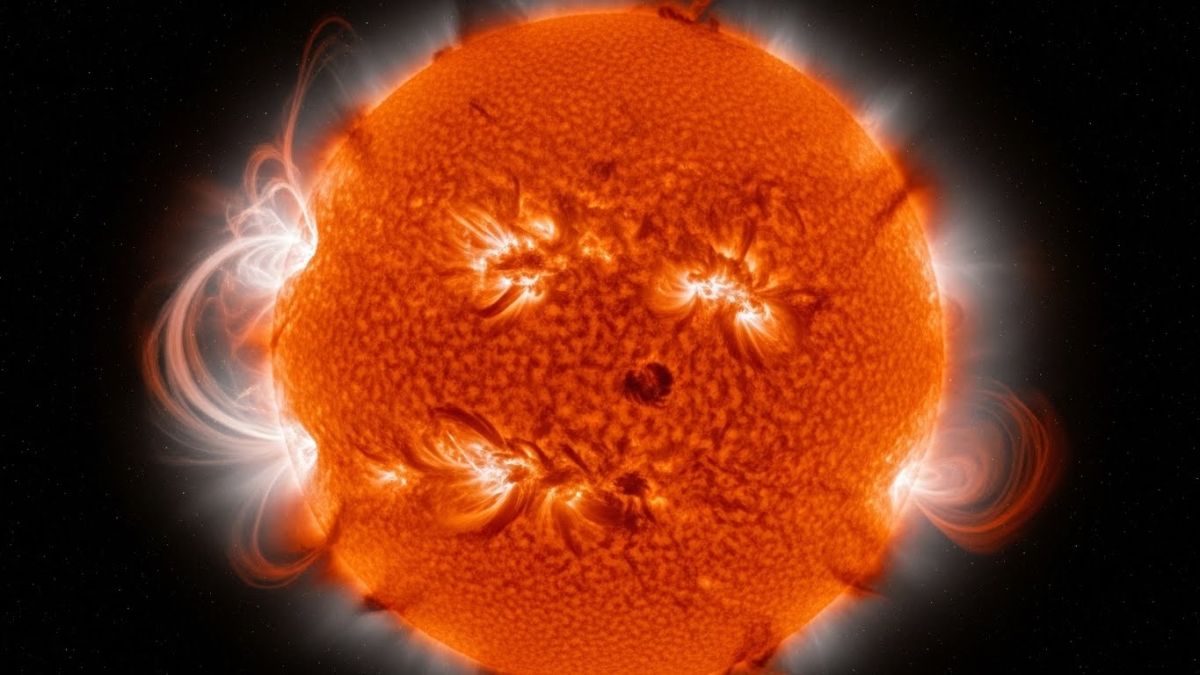
Key Facts About the Sun
| Category | Value | Comparison to Earth |
|---|---|---|
| Diameter | ~13.9 Lakh km | ~109 times Earth |
| Mass | ~1.989 × 10³⁰ kg | ~3.3 Lakh times Earth |
| Volume | ~1.41 × 10¹⁸ km³ | ~13 Lakh Earths fit inside |
| Distance from Earth | ~15 Crore km (1 AU) |
8 minutes 19 seconds at light speed |
| Surface Temperature | ~5,500°C | ~5 times hotter than lava |
| Core Temperature | ~1.5 Crore °C | 2,700 times hotter than surface |
| Age | ~4.6 Billion years | Middle-aged star |
Source: NASA Sun Fact Sheet
1. The Sun's Interior Structure
If we could slice the Sun in half, what would we see?
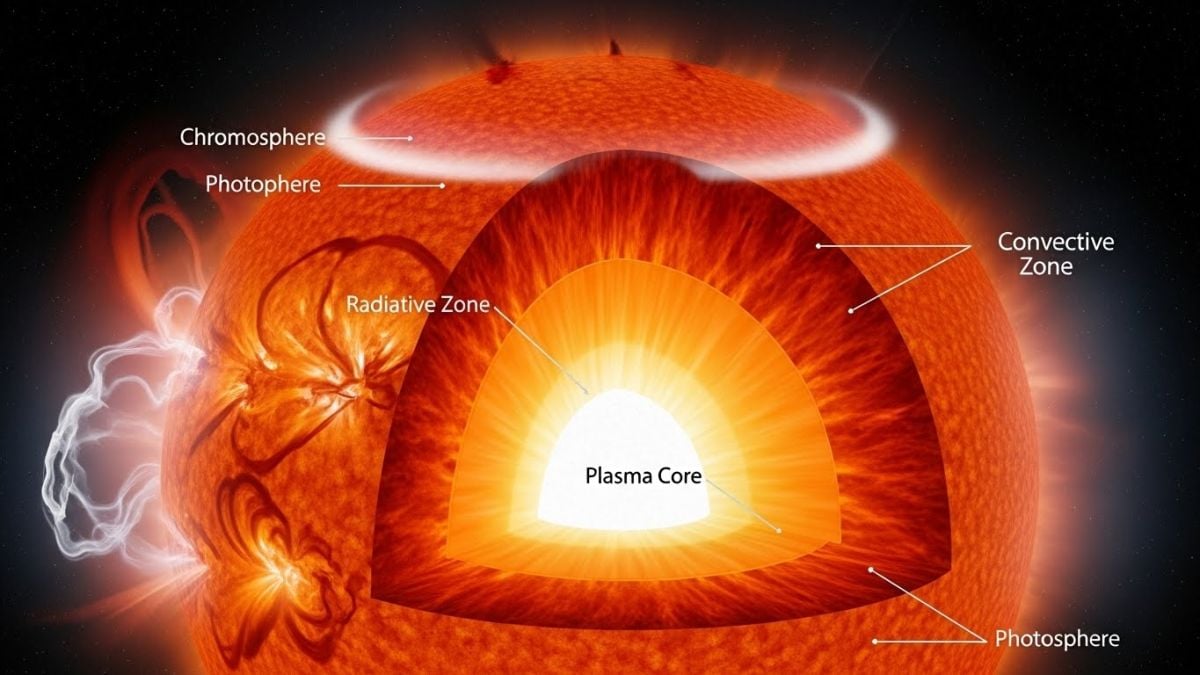
The interior is divided into three main layers: the Core, the Radiative Zone, and the Convective Zone. Each layer has a unique method of creating or transporting energy. Think of it like a boiled egg with a yolk, white, and shell—each part plays a distinct role.

1-1. The Core: The Power Plant
The Core occupies about 20-25% of the Sun's radius. While it's only a quarter of the size, this is where all the energy is born.
The conditions here are extreme. The temperature is about 1.5 Crore degrees Celsius. In this environment, matter exists as "plasma"—a soup of electrons and atomic nuclei buzzing around.
Here, hydrogen nuclei collide at high speeds and fuse to form helium. This is Nuclear Fusion.
When four hydrogen nuclei fuse into one helium nucleus, a tiny bit of mass is lost. Where does it go? Following Einstein's famous equation E=mc², that mass is converted directly into energy.
The Sun converts about 60 Crore tonnes of hydrogen into helium every second. Of that, about 40 Lakh tonnes constitute pure energy released into space. Despite this massive consumption, the Sun is so huge it won't run out of fuel for another 5 billion years.
1-2. The Radiative Zone: The Long Journey
Energy born in the core doesn't just fly out instantly. It must first pass through the "Radiative Zone."
This zone covers about 70% of the Sun's radius. Here, energy travels as photons (light particles). However, the plasma is so dense that photons cannot travel in a straight line.
A photon travels a tiny distance, hits a particle, gets absorbed, and is re-emitted in a random direction. This game of "pinball" happens trillions of times. Because of this "random walk," it takes about 1.7 Lakh years for a photon to escape from the core to the surface (Source: Stanford Solar Center).
The sunlight hitting your face today was actually created in the centre of the Sun before human civilisation even began.
1-3. The Convective Zone: The Boiling Pot
The outer 30% of the solar interior is the "Convective Zone." Here, the transport of energy changes dramatically.
As the temperature drops from about 20 Lakh °C to 5,500 °C near the surface, the plasma becomes too opaque for radiation to work efficiently. Instead, convection takes over.
Imagine a pot of boiling milk or dal on the stove. The heat from the bottom causes the liquid to rise, bubble, and circulate. The Sun does the same thing.
This movement creates patterns on the surface called "granules." Each granule is roughly 1,000 km across—about the size of the state of Rajasthan—and lasts only 8 to 20 minutes. The surface of the Sun is literally boiling.
| Layer | % of Radius | Temperature | Energy Transport |
|---|---|---|---|
| Core | 0-25% | ~1.5 Crore °C | Nuclear Fusion |
| Radiative Zone | 25-70% | ~70 Lakh to 20 Lakh °C | Radiation (Photons) |
| Convective Zone | 70-100% | ~20 Lakh to 5,500 °C | Convection (Plasma flow) |
2. The Solar Atmosphere
Surrounding the main body of the Sun is its atmosphere, consisting of three layers: the Photosphere, the Chromosphere, and the Corona.
2-1. The Photosphere
When we "look" at the Sun (never look directly!), we are seeing the Photosphere. This is the visible surface.
It is relatively thin, only about 500 km deep. The temperature here is about 5,500°C, giving the Sun its yellow-white colour.
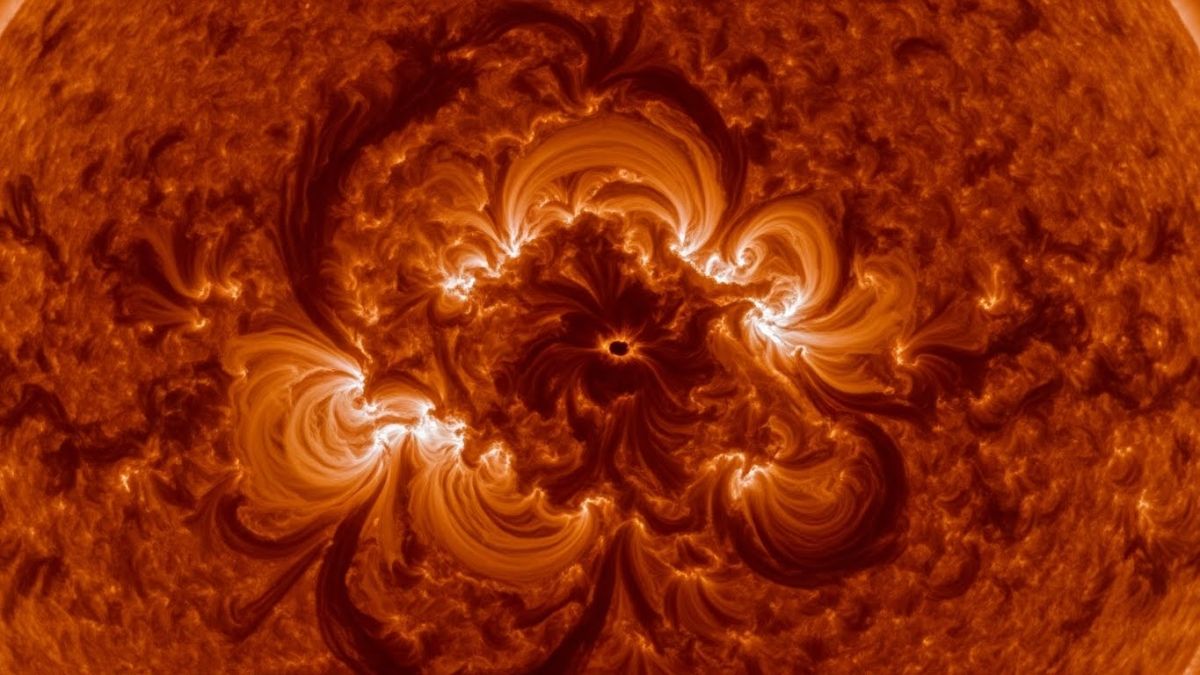
The most famous features here are Sunspots. These are dark patches on the surface that appear black only because they are cooler (~4,000°C) than the surrounding area.
2-2. The Chromosphere
Just above the photosphere lies the Chromosphere ("Sphere of Colour"). Usually invisible due to the glare of the photosphere, it can be seen as a reddish ring during a total solar eclipse.
Interestingly, the temperature here actually rises as you go further out, reaching up to 20,000°C.
2-3. The Corona
The outermost layer is the Corona (Latin for "Crown"). This pearly white halo extends millions of kilometres into space.
The Corona presents a major scientific mystery: its temperature soars to 10 to 30 Lakh degrees Celsius. Why is the atmosphere much hotter than the surface? It's like walking away from a fire and feeling hotter.
India's solar mission, Aditya-L1, is currently observing the Sun to help solve this specific mystery of "Coronal Heating."
3. Solar Activity
The Sun is not a quiet, static ball of light. It is a dynamic, active star.
3-1. Sunspots and the 11-Year Cycle
The number of sunspots increases and decreases in a regular cycle of about 11 years. This is known as the Solar Cycle.
During "Solar Maximum," sunspots are numerous, and solar flares are frequent. During "Solar Minimum," the sun can be spotless for days.
3-2. Solar Flares and CMEs
Sometimes, magnetic energy near sunspots is released explosively. This is a Solar Flare. A flare can release the energy equivalent of millions of hydrogen bombs in minutes.
3-3. Solar Wind and Auroras
The Sun constantly emits a stream of charged particles called the Solar Wind. When these particles hit Earth's magnetic field, they create the beautiful **Auroras** (Northern and Southern Lights) near the poles. While rarely visible from India (except occasionally from high-altitude regions like Hanle, Ladakh during intense storms), they are a direct result of solar activity.
▶ Related Article: What is a Solar Flare? Mechanisms and Effects Explained
4. The Lifecycle of the Sun
Like all stars, the Sun has a birth and will eventually have a death.
4-1. Birth to Present
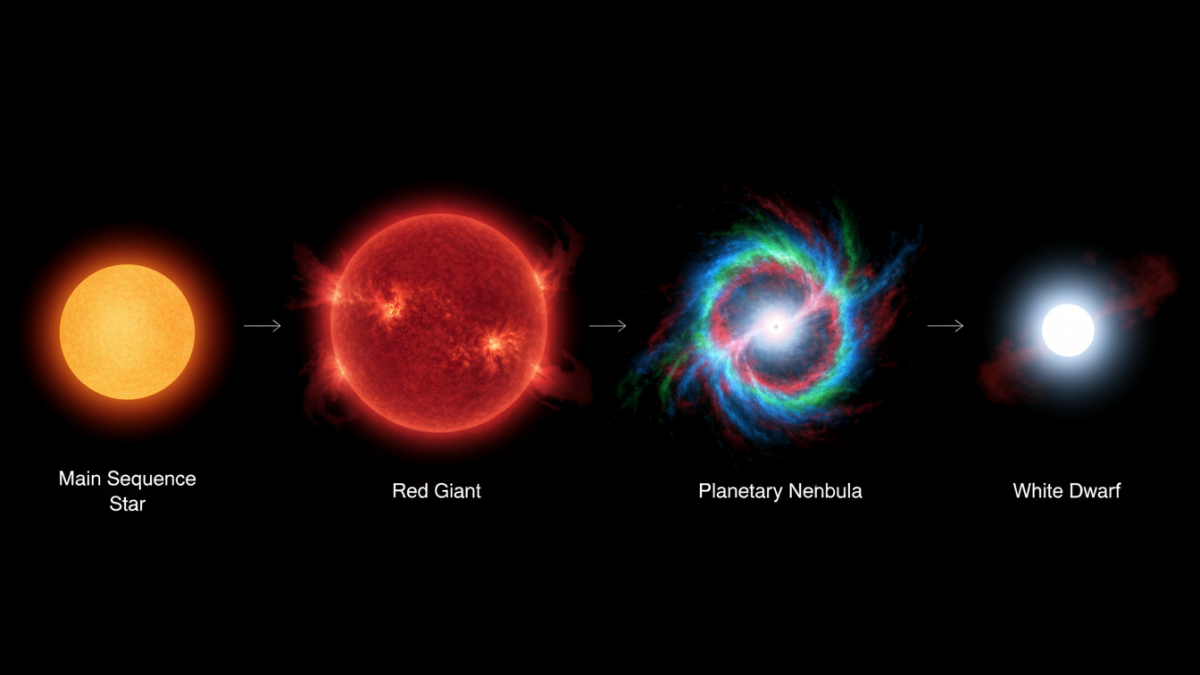
About 4.6 billion years ago, a giant molecular cloud collapsed under gravity to form our Sun. It is currently a "Main Sequence" star, happily burning hydrogen into helium. It is about halfway through its life.
4-2. The Red Giant Phase
In about 5 billion years, the hydrogen fuel in the core will run out. The core will shrink, but the outer layers will expand massively. The Sun will become a Red Giant.
It will grow so large that it will swallow Mercury and Venus, and possibly Earth. Even if Earth isn't swallowed, the intense heat will boil the oceans.
4-3. The End: White Dwarf
After the Red Giant phase, the Sun will shed its outer layers into space, creating a beautiful Planetary Nebula.
What remains of the core will be a White Dwarf. It will be about the size of Earth but incredibly dense. The Sun will not explode; it will simply fade away over billions of years.
5. Common Misconceptions
5-1. "The Sun is on Fire"
Fire requires oxygen. There is no oxygen burning in space. The Sun glows because of nuclear fusion, which is far more powerful than chemical fire.
5-2. "The Sun is Yellow"
If you viewed the Sun from space, it would look white. It appears yellow or orange on Earth because our atmosphere scatters blue light.
Frequently Asked Questions (FAQ)
Q: How long does it take for sunlight to reach Earth?
A: It takes about 8 minutes and 19 seconds. Light travels at approx 3 Lakh km/s. However, energy from the core takes roughly 1.7 Lakh years to reach the surface.
Q: What would happen if the Sun disappeared?
A: For the first 8 minutes, we wouldn't know. After that, Earth would lose its orbit and fly into deep space, and temperatures would drop rapidly.
Q: Is it safe to look at the Sun with sunglasses?
A: No! Standard sunglasses do not protect your eyes. Looking directly at the Sun can permanently damage your retina. Always use ISO-certified solar viewing glasses.
References & Further Reading
- ISRO (Indian Space Research Organisation) - Aditya-L1: https://www.isro.gov.in/
- NASA Sun Fact Sheet: https://nssdc.gsfc.nasa.gov/planetary/factsheet/sunfact.html
- Stanford Solar Center: http://solar-center.stanford.edu/